Ua Toe Fa'afouina e le Vaitau o Pateta 2026 le Fefa'ataua'iga a le CIS
Interim 2026 data show sharply different potato balances across the CIS: Russia harvested less than a year earlier, Central Asian output expanded, and trade restrictions reshaped regional flows.
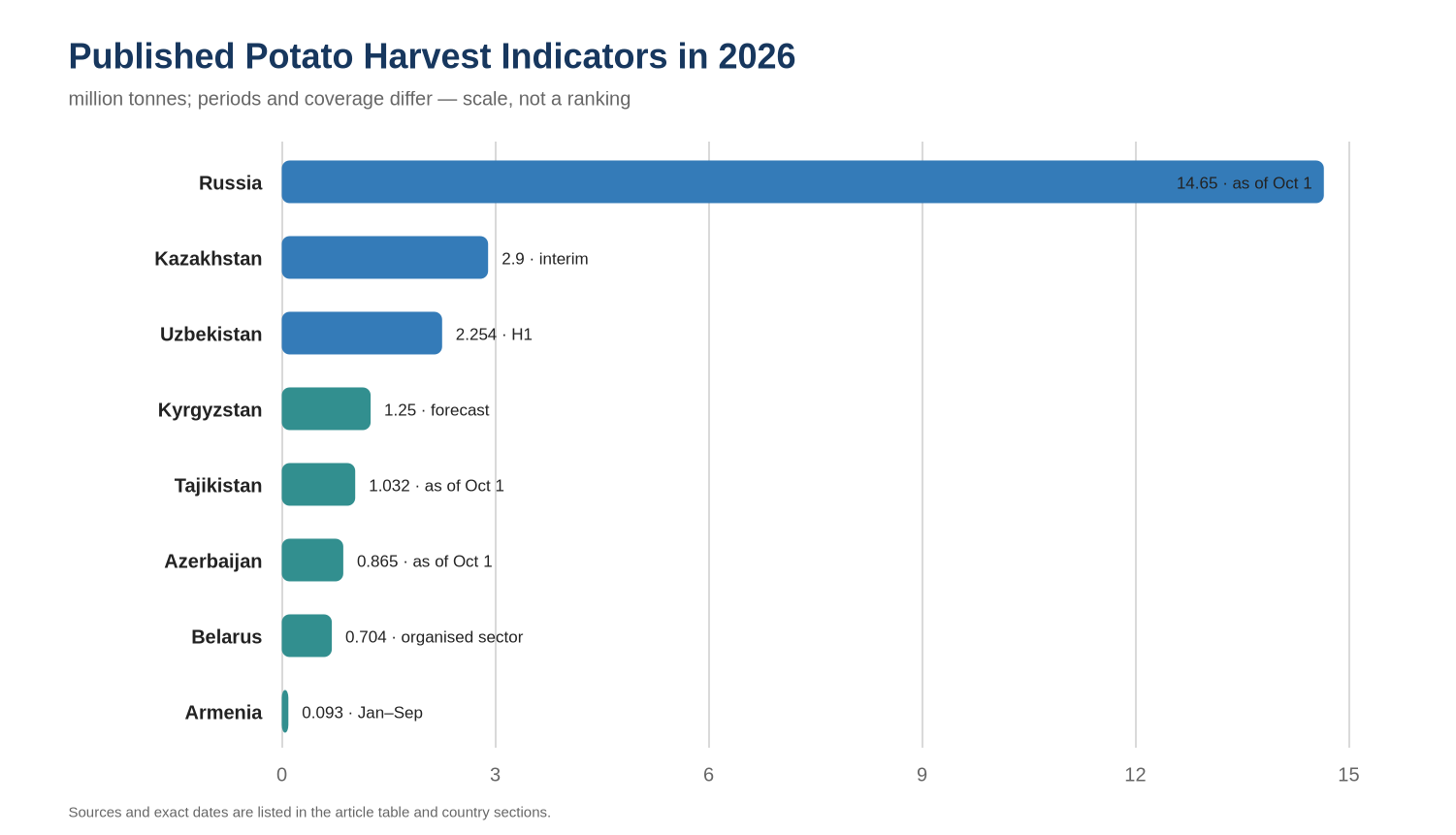
By 11 November 2026, most CIS countries have not yet published final annual potato balances, so an honest season summary is compiled from operational collections, forecasts, and partial statistical snapshots. The picture is heterogeneous: Russia harvested less potato than on the same date in the strong 2025 year; Belarus’s organized sector saw increased yields; Kazakhstan kept production roughly at last‑year levels; Kyrgyzstan and Tajikistan expanded their harvests; Uzbekistan simultaneously broadened production and remained the largest regional importer. Armenia and Azerbaijan showed slight declines, but data for Armenia are contradictory, and there is no national total for Turkmenistan. Intra‑regional trade is driven not only by harvest volumes: Kyrgyzstan closed imports until March 2027, Russia restricted Armenian sub‑quarantine product, and Kazakhstan cemented its role as the main potato supplier to Uzbekistan. The season’s key takeaway is not an overall CIS deficit or surplus, but the divergence of national balances, harvest timings, tuber quality, and market‑access regimes.
2026 Results Remain Operational
In this review, “CIS republics” refer to the eight full participants — Azerbaijan, Armenia, Belarus, Kazakhstan, Kyrgyzstan, Russia, Tajikistan, and Uzbekistan — plus Turkmenistan as an associate member. Moldova is listed separately: the notification of its withdrawal from the founding documents was deposited on 8 April 2026, and the twelve‑month period stipulated by the Charter had not yet elapsed as of the review date (CIS Executive Committee). Ukraine remains a founding state that has not ratified the Charter and is not among the eight full participants; Georgia terminated its membership on 18 August 2009 (CIS Executive Committee; CIS history). Consequently, Ukraine and Georgia appear below only as trade partners.
The summary table is not a ranking: countries publish data with varying coverage. In Russia, the operational figure includes all farm categories; in Belarus, it primarily covers agricultural producers; Moldova reports yields of large farms; and the Uzbek figure pertains solely to the first half‑year.
Aso o le vaiaso. Fa'aleaogaina le lesitala i le tasi kiliki.
| atunuu | Last verified figure as of 11.11.2026 | Status and coverage |
|---|---|---|
| Lusia | 14.65 million t as of 1 October | Operational, all categories, 87 % of area harvested (Kommersant) |
| Belarus | 704 thousand t, 333 c/ha | Operational, agricultural producers, not all farms (Minagro via 4esnok.by) |
| Moldavia | 246.3 c/ha | January–September, only agricultural enterprises and farmers ≥ 50 ha (NBS Moldova) |
| Armenia | 93.0 thousand t | January–September, operational, ‑1.2 % year‑on‑year (ARKA) |
| Azerbaijan | 864.8 thousand t as of 1 October | Fa'agaioiga, ‑1.1 % year‑on‑year (Komiti o Fuainumera a le Setete) |
| Kazakhstan | 2.9 million t | Operational report from Ministry of Agriculture, not final statistics (Malo o Kazakhstan) |
| Kyrgzstan | 1.2497 million t | Official forecast, not a completed result (Ministry of Agriculture of Kyrgyzstan) |
| Tajikistan | 1,031,647 t as of 1 October | National operational estimate (Ministry of Agriculture of Tajikistan) |
| Uzbekistan | 2.2543 million t for H1 | Half‑year fact; 4.5 million t – annual target, not result (SIAT; Matagaluega o Faatoaga) |
| Turkmenistan | No national total | Only separate regional data available (State Information Agency) |
Russia, Belarus, and Moldova Show Divergent Market Trajectories
Lusia. As of October 1, all categories of farms had harvested 14.65 miliona tone, down 8.7% year-on-year; harvesting covered 87% of planted areas. Agricultural organizations accounted for 3.1 million tonnes, farmers for 2.1 million tonnes, and household farms for 9.5 million tonnes (Kommersant). Comparing these 14.65 million tonnes with the commercial sector forecast is not appropriate: the Ministry of Agriculture uses a narrower definition of organized production. For a consistent baseline, the EAEU reports 19.5107 million tonnes from 991.6 thousand hectares at a yield of 198 centners per hectare for 2025 across all categories, up 9.4% from 2024 (EAEU).
The arrival of the new harvest has driven prices lower. In September, the Ministry of Agriculture reported a monthly decline in producer prices by 12.3% to 26.3 rubles/kg and consumer prices by 16.5% (Vedomosti); during the week of September 29 to October 5, Rosstat recorded an additional 2.3% drop in retail prices (Rosstat). While this confirms seasonal price reductions, it does not allow assessment of the winter balance without final commodity collection data, quality metrics, and storage loss figures.
Belarus. By October 23, agricultural producers had harvested 704 afe tone at a yield of 333 sene i le eka, 25 centners per hectare higher than last year (Ministry of Agriculture via 4esnok.by). This figure pertains to the organized sector and planned acreage of approximately 22 thousand hectares. The full national total for 2025 was significantly higher—3.0472 million tonnes from 139.9 thousand hectares at 219 centners per hectare—as the EAEU includes all farm categories (EAEU). This gap is crucial for analysis: the state agro-industrial program notes that between 2020 and 2024, production in household farms declined by 2 million tonnes, or 1.8-fold (Future Agro-Industrial Program). Consequently, high yields among large producers do not equate to growth in overall national supply.
Russia remains the most important external market for Belarusian potatoes, but volumes fluctuate with the Russian season. In 2024, deliveries from Belarus to Russia totaled 201.2 thousand tonnes, while by May 25, 2025, they stood at 32 thousand tonnes compared to 63.9 thousand tonnes the previous year. Simultaneously, total Russian imports reached 548.1 thousand tonnes by that date, primarily sourced from Egypt and China (Rosselkhoznadzor via TASS/Alta-Soft). Complete open data on Belarusian potato exports for 2026 are unavailable as of the review date.
Moldova. The national gross harvest for 2026 has not yet been published. Average potato yields in agricultural enterprises and farm holdings of at least 50 hectares amounted to 246.3 sene i le eka during January–September, or 128.7% of the previous year’s level (National Bureau of Statistics of Moldova). However, this snapshot covers only a small segment of the industry: as of July 1, 97% of potato-growing land was held by households and small farms (National Bureau of Statistics of Moldova). Therefore, increases in yields among large-scale operations cannot be extrapolated into a national estimate.
Moldova’s trade profile is increasingly oriented toward the EU. From January to August 2026, CIS countries accounted for only 2.7% of total Moldovan imports, while the EU represented 53.6%; this figure reflects overall trade, not specifically potato-related flows (National Bureau of Statistics of Moldova). A comparable official HS 0701 country breakdown for potato trade was not available in the reviewed publications, so no 2026 product-level trade estimate is presented.
South Caucasus Links Harvest with Phytosanitary Access
Armenia. For the January–September period, 93.0 thousand tonnes of potatoes were produced, 1.2 % less year‑on‑year; total crop output fell by 7.3 % (ARKA citing Armstat). This is an operational nine‑month indicator; a conflicting secondary figure was excluded from the assessment.
The main seasonal event for Armenian trade was the Russian restrictions. From 3 June, the import of potatoes and a range of other sub‑quarantine products was temporarily limited due to demands for delivery verification and traceability; from 12 June the restriction was extended to all sub‑quarantine products, and Armenia appealed to the EAEU (Public Radio of Armenia; Interfax). No document confirming a full removal or easing of the regime before 11 November was found in the examined sources. This episode demonstrates that EAEU membership does not eliminate quarantine control.
Azerbaijan. By 1 October, 864.8 thousand tonnes had been harvested, 1.1 % less year‑on‑year. By 1 September the figure was still 777.2 thousand tonnes, 2.2 % above the previous year, so the late harvest altered the trend; no official explanation for this reversal has been provided (Komiti o Fuainumera a le Setete o Azerbaijan; Lipoti Aukuso).
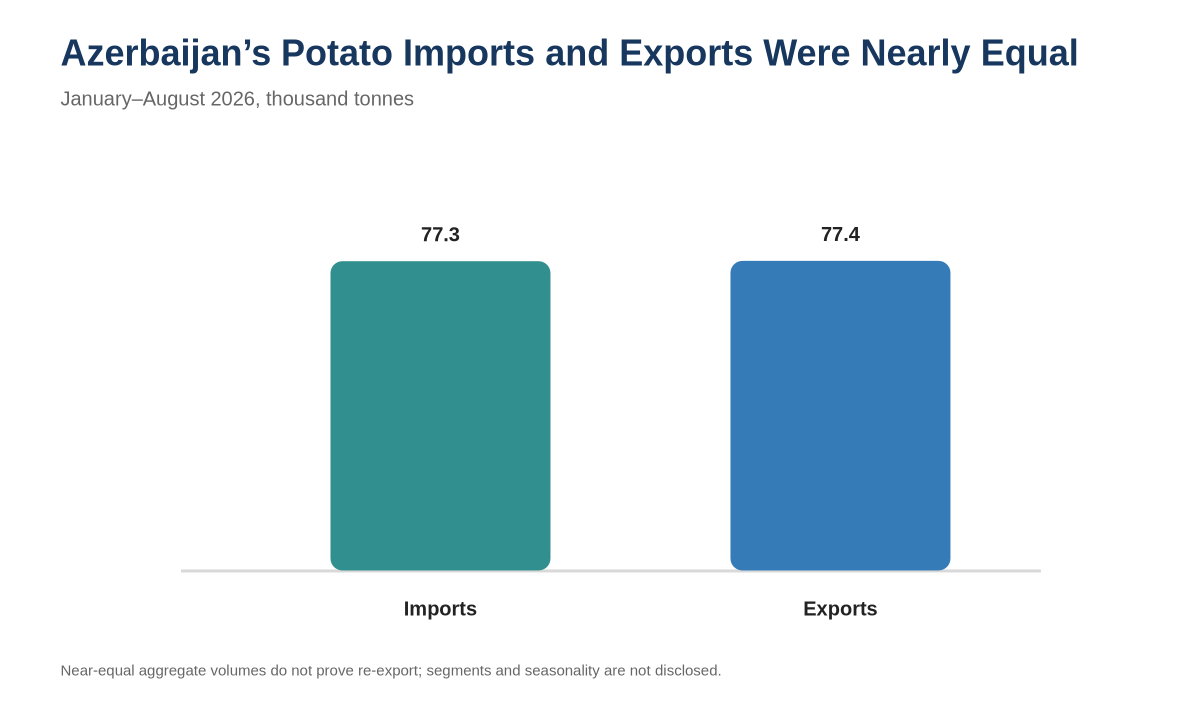
Azerbaijan is simultaneously an importer and exporter. In January–August 2026 the country imported 77 330.2 tonnes of potatoes worth $29.73 million and exported 77 407.9 tonnes worth $29.71 million (Komiti o Fuainumera a le Setete). The near‑identical aggregated volumes do not prove re‑export; they may reflect seasonality, geography, and different product segments. In 2025, according to a publication referencing national statistics, out of 71 430 tonnes exported, 59 975 tonnes went to Russia and 5 693 tonnes to Belarus; imports came mainly from Turkey, Georgia, Pakistan, Russia and Iran (ABC.az). By 8 May 2026 Russia had received 6.7 thousand tonnes of Azerbaijani potatoes, 41.9 % more year‑on‑year (Interfax).
Neighbouring Georgia, not a CIS member, remains part of this seasonal system. In January–September it supplied Azerbaijan with 12.7 thousand tonnes of potatoes worth $2.4 million, as well as 3.4 thousand tonnes to Russia and 2.1 thousand tonnes to Belarus (BM.GE). For Azerbaijan this further confirms the bilateral nature of the market: the country exports its own harvest northward while simultaneously covering internal temporary and quality gaps with imports from the west and south. However, available statistics do not separate seed from food‑grade potatoes, so the drivers of the opposite flows cannot be described more precisely without customs‑level data.
Central Asia Increases Harvests but Maintains Imports
Kazakhstan. The Ministry of Agriculture reported an early harvest of 2.9 miliona tone; the September forecast had projected 2.8 million tonnes, roughly in line with 2025 levels (Malo o Kazakhstan; September briefing). As of September 11, 1.8903 million tonnes were harvested from 74,000 hectares at 255.5 centners per hectare, compared to 242.8 centners per hectare the previous year (Igilisi). Field prices stood at 90–100 tenge/kg by late September. Authorities deemed storage facilities adequate and announced the commissioning of over 700,000 tonnes of new capacity within three years; natural losses during harvesting, transportation, and storage were estimated at 5–10% (Malo o Kazakhstan).
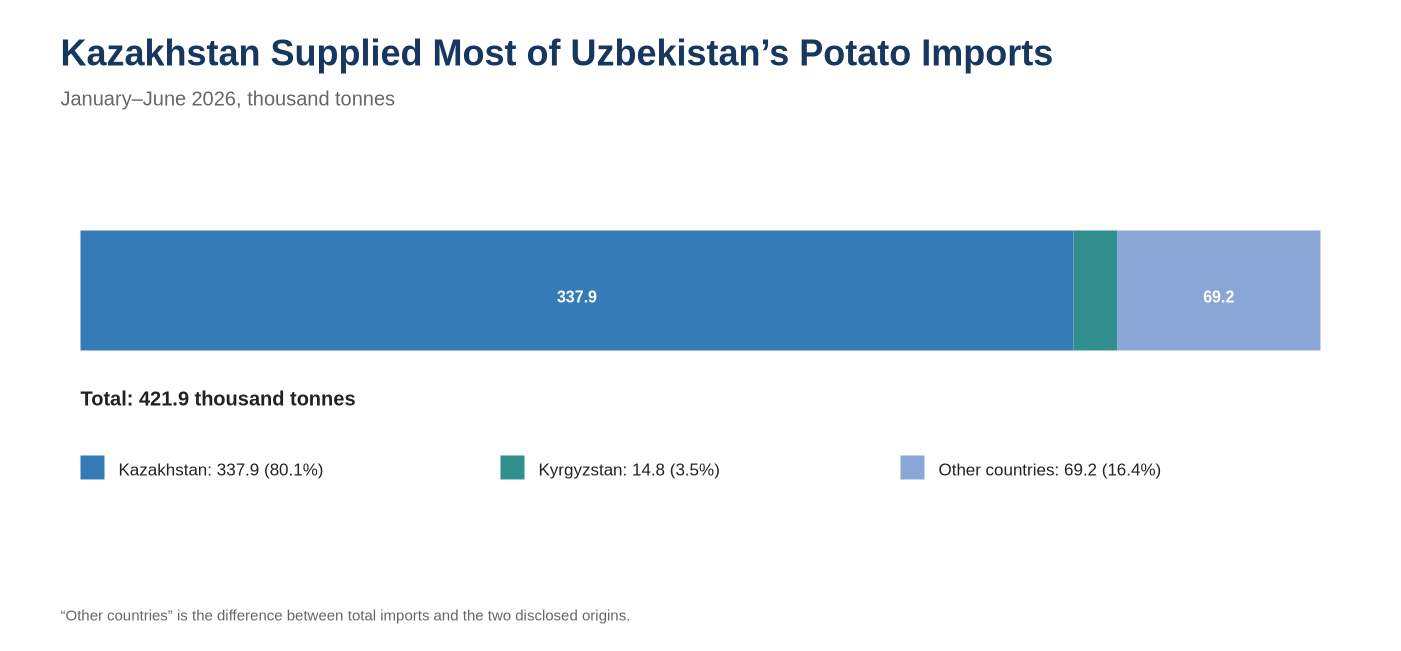
Kazakhstan’s export potential for 2026 was estimated at 400,000 tonnes, up from 388,000 tonnes in 2025. In the first half of the year alone, Uzbekistan imported 337,900 tone from Kazakhstan, making the Kazakh harvest pivotal for regional supply balances (Komiti Fa'ale-Atunu'u o Fuainumera a Uzbekistan).
Kyrgzstan. By May 23, potatoes occupied 44,700 hectares, 3% more year-on-year (National Statistics Committee). At the interim harvesting stage, total production reached 359,900 tonnes, exceeding last year’s figure by 8.5%; yields increased from 167.0 to 171.8 centners per hectare (National Statistics Committee). The Ministry of Agriculture forecast an annual harvest of 1.2497 miliona tone, with domestic consumption at 779,700 tonnes and self-sufficiency estimated at 181.9%. Based on these figures, on October 16 Kyrgyzstan imposed a temporary ban on potato imports until March 1, 2027, with exceptions for transit and specific purposes (Ministry of Agriculture of Kyrgyzstan). The actual impact of this measure on prices and neighboring trade flows remains unmeasured.
Tajikistan. Plantings covered 68,000 hectares, 3,600 hectares more than in 2025. By October 1, 1,031,647 tone had been harvested, 135,128 tonnes more than the previous year (Ministry of Agriculture of Tajikistan). No product-level import total is included because the reviewed official publication did not provide a comparable customs table.
Uzbekistan. The official SIAT database records 2.2543 miliona tone for the first half of the year (SIAT). The annual target stands at 4.5 million tonnes, compared to 4.1 million tonnes actually produced in 2025; additional replanting was expected to yield November harvests, so this goal should not be presented as final (Ministry of Agriculture of Uzbekistan). Supply expansion has already influenced prices: the ministry reported average prices falling from 5,717 to 4,169 soums/kg, while farmer-level wholesale prices ranged from 2,500 to 2,800 soums/kg. Inter-seasonal reserves were estimated at 400,000 tonnes, including 216,000 tonnes stored in cold storage facilities (Matagaluega o Faatoaga).
A separate focus area is reducing reliance on imported seed stock. A state program aims to produce 4 million mini-tubers in 2026 and increase high-replication seed potato output to 747,000 tonnes by 2030; this represents a planned trajectory rather than confirmed actual production for the current season (Ministry of Agriculture of Uzbekistan). The agency also published varying acreage estimates—284,000 hectares in the January plan versus 238,000 main plantings plus 71,000 replantings in the August description. These categories cannot be mechanically summed or compared without methodological clarification.
Despite rising production, Uzbekistan imported 421,918 tone of potatoes worth $34 million between January and June—46,900 tonnes less year-on-year. Besides Kazakhstan, 14,800 tonnes came from Kyrgyzstan; significant volumes also originated from Pakistan and Afghanistan (Komiti Fa'ale-Atunu'u o Fuainumera a Uzbekistan). Importation amid substantial domestic harvest reflects seasonal demand patterns, early deliveries, and distinctions between seed and market-grade products; exact proportions remain undisclosed in publicly available summaries.
Turkmenistan. National acreage, gross harvest, yields, prices, and foreign trade data for potatoes in 2026 have not been published in accessible official statistics. In Lebap velayat, over 19,600 tone were harvested from 1,400 hectares in spring, based on declared yields of 140 centners per hectare (State Information Agency of Turkmenistan); in Dashoguz velayat, potatoes occupied 8,800 hectares, but a June publication merely noted the start of harvesting (State Information Agency). Regional figures cannot be aggregated into national estimates. An agreement with Kazakhstan to expand a “green corridor” for fruit and vegetable products confirms trade interest but does not disclose potato volumes for 2026 (Ministry of National Economy of Kazakhstan).
EAEU Facilitates Trade but Does Not Eliminate Controls
The regional market operates under multiple legal frameworks. Armenia, Belarus, Kazakhstan, Kyrgyzstan, and Russia belong to the Eurasian Economic Union (EAEU), which provides a unified customs space. However, each consignment of regulated products undergoes quarantine phytosanitary inspection, and high-risk goods require certificates from exporting or re-exporting countries (EEC). For potatoes, requirements include freedom from quarantine organisms, origin labeling, and exporter certification; seed potatoes are subject to additional regulations (Unified EAEU Requirements). Russia’s restriction on Armenian products served as practical confirmation that free movement does not equate to zero oversight.
The 2011 CIS Free Trade Zone Agreement was signed by Armenia, Belarus, Kazakhstan, Kyrgyzstan, Moldova, Russia, Tajikistan, and Ukraine; Uzbekistan acceded via a separate protocol. Azerbaijan and Turkmenistan are not parties to this agreement, so general rules of duty-free trade cannot be applied to them (CIS Executive Committee). Even among signatories, actual market access depends on product origin, HS code, and existing restrictions. The register of barriers to mutual trade continued updating in 2026, indicating that the free trade legal framework has not eliminated all non-tariff obstacles (CIS Executive Committee).
For Moldova, transitional status is particularly significant. The government initiated denunciation of founding documents but simultaneously stated that beneficial economic and trade agreements would remain in force (Malo o Moldova). In October, CIS experts were still determining which treaties would continue after the withdrawal process concluded (CIS Executive Committee). Consequently, tariff treatment for any given shipment cannot be inferred solely from the political narrative of “Moldova leaving the CIS”; relevant treaties, origins, and transaction dates must be verified individually.
Three main axes shape actual trade flows. First is Russia and Belarus, where Russian harvests and import policies rapidly alter demand for Belarusian products. Second comprises Kazakhstan, Uzbekistan, Kyrgyzstan, and Tajikistan: Kazakhstan serves as the largest confirmed supplier, Uzbekistan acts as a demand hub, and Kyrgyzstan temporarily suspended imports following a bumper harvest. Third involves Azerbaijan and Russia, where Azerbaijani potatoes maintain a stable presence but pass through the external customs and phytosanitary checkpoints of the EAEU. Moldova is increasingly integrated into the EU market while preserving select economic agreements during its transitional exit from the CIS (Malo o Moldova).
iʻuga
The 2026 season does not permit conclusions about a single, unified CIS potato balance. Russia recorded lower yields compared to the same period last year but remains the largest market; Belarus improved yields in the organized sector while facing declining domestic production; Kazakhstan retained export potential; Kyrgyzstan and Tajikistan expanded supply; and Uzbekistan combined production growth with substantial imports. In the South Caucasus, minor changes in gross harvest proved less critical than market access and phytosanitary constraints.
For trade, decisive factors extend beyond mere millions of tonnes to include timing of harvest arrivals, tuber fraction and quality, storage availability, product origin, and traceability. Therefore, regional flows will continue to reallocate even when aggregate production appears sufficient. Final assessments of each country’s self-sufficiency can only be made after complete annual balance sheets and comparable trade and inventory statistics become available.
Data cutoff: 11 November 2026. Final national balances were not yet available for most countries; operational figures, forecasts and partial-year data are labelled accordingly.